Wednesday, 5 April 2017

Ants and Woodland

It has been a while since the last blog entry. Other matters have taken up time but now with the days already wonderfully long - daylight from 6am till 8pm - I have a little more time to go and explore and observe once more.

Having moved, new 'hunting grounds' are available. One of which is an area of woodland only 5 minutes from my doorstep. Parts of it are said to be ancient.

It appears 'from the outside' a small area but once inside, it is an never ending oasis of small worlds to discover. It is riddled with wide and narrow footpath, some frequently used, others hardly visible. A stream enters the woodland, gently making its way over stones and filling the area with relaxing sounds of water as it flows over stones. The stream makes its way through the woodland, its winding path offering some great views with its banks full of Woodland Anemone. Soon the ground will be covered in bluebells.


The woodland has many 'micro' worlds, offering home to many creatures and it is filled with the sing song of birds. I shall film it one day.


Now covered with Woodland Anemone, soon to be followed by a carpet of blue bells.


But my main reason for coming here are a very particular type of insect: the woodland Ants. There are at least 4 huge nests in this woodland and all the ants are busy going about their daily tasks. If I time it right I can 'catch' them while they still 'wake up'. 

The ants are very sluggish early in the morning, just like most of us once we have managed to crawl from under the duvet. While in our case its mostly tiredness, in the ant's case it is most likely due to temperature rises; I have noticed them being much slower in cold temperatures, but when I go and re-visit when it has warmed up, they all move much quicker and in far greater numbers.  This in turn is a challenge for my photography as I don't use a tripod or any other help but my steady hands. But there is a limit to how calmly I can follow an ant racing up and down the stem of a tree ... hence why I prefer to visit them early when they are slower, and less bothered by my presence.


 Some sort of exchange - whenever two ants cross paths, a quick exchange of some sort takes place, it doesn't always look friendly. Perhaps the ant on the right is being told off for being lazy ... ;)


This little excited chap above was not at all keen on my lens being so close up. They are certainly not shy! While other insects fly off and go and hide, these little creatures are a feisty bunch and stand their ground; size doesn't matter!


While others are far more interested to make a good appearance ... such as this little ant here, not at all bothered by my lens and it spent ages grooming itself.


The woodland is filled with very old fir trees. Their bark is a fantastic background! I spent some time observing this ant (above and below) and wasn't quite sure what it was trying to do; you may just be able to make it out: there are some strands of spider silk spun across the bark. For some reason, this ant kept walking into them, only to then spend ages struggling to get out. It did this several times. Not sure what the purpose of the exercise was.


If meant to be I shall return to my little friends over the weekend. A most amusing and astounding bunch to observe.


Saturday, 7 January 2017

And nature always is

Matters have settled down a little and with the days now becoming longer there is more time to photograph. Life is still quite, so it seems ... but upon closer inspection it has of course never stopped.
Although there are not yet many insects about - though I have seen some tiny types of woodlice - other life forms continue being.


It was a frosty morning and I was waiting for the sun to be up high enough in the sky so it could warm up the ground a little. As that didn't happen, I found some warmth near the stonewalls. In the heavy stroms in 2014, two huge chestnut trees had come down and they have by now become home for all kind of fungus and no doubt will be visited by countless insects when it warms up.

The above I only spotted because I was curious as to what the tiny orange blobs are on a fairly sizeable piece of 'old' tree branch lying on the wet ground. Getting close up I realised that it was some type of fungus. I am no specialist in this are so am yet to find out what type of fungus it is. Any knowledgeable reader is welcome to share of course.


Further on, the actual fallen tree (which was huge) is slowly being covered by all kind of different fungus - none of which I yet can ID but am in progress of finding out. This specimen here caught my attention because of its warm cream/brown/orange colour and I was surprised to find that their texture is of the velvety fury kind.


And of course ever abundant around here on stonewalls and 'dead' wood - lichen (and moss). Lichen being one of the oldest life forms on this earth ... there is a specific page on this blog that I have reserved for it. 


And lastly this bit of green vegetation, covered in hundreds of sparkly dew drops that have just de-frosted.


Tuesday, 16 August 2016

Time Flies

I have not had much time recently to post here, partly due to working 7/7 but also because the 'hunting' ground has been cut down to make haylage. This means the habitat of all the insects that I had the pleasure to observe has been removed and with that the insects too have dissapeared.

Therefore I have to travel further and find different spots, otherwise I am seeing the same insects over and over as there is now not much variety in the grazing fields.

Still, I do get the odd moment when I have time and the weather is suitable (i.e. light and windstill) but the majority of photographs is posted on Instagram:

For those that don't know: instagram is a handy little social media app where people worldwide share photographs. Why not join POTR on instagram to keep up-to-date?  Username:  pixelsontherocks

Perhaps see you there! :)

I will post here and share all the discoveries from the summer months once the days are shorter and the evenings draw in. But while the sun is shining, I make the most of it by being outside!

Till very soon ...


Friday, 8 July 2016

Haylage Meadows - Habitat Gone

It is the time of the year ... July is THE month for all the haylage making nearby. While this is great news for the farmers and their livestock as well as all horse owners, it is quite bad news for all the insects that have taken up residence in the long grasses.

Indeed one of my favrouite hunting patches has fallen victim to haylage making. Early this week, near midnight even, the tractors were out, cutting down all the fields that had been left untouched for nearly 2 years.

I woke up and when I saw it I was close to running out and to lie down in front of the tractor!  All the caterpillars that I had watched up there, all the little spots for various bugs that I had found and repeatedly visited, all gone.

The weather since hasn't been good enough to go and visit the fields again, at least along the stonewalls some of the long grasses are still there and of course all those insects that took up residence in the brambles are fine. No machine messes with brambles!


The most unfortunate part of it is this one cocoon (below) that I had been watching for weeks - the cocoon of a burnett moth caterpillar. I saw it make it and went to visit it every week. It would have been time just about now for the moth to emerge but it won't have survived the tractor wheels and the cutting. Just a day before they were cutting I went to visit it and it looked as though it was just about ready ... A great shame really as I was hoping to photograph it's last stages before emerging.


But alas, the world keeps turning and life goes on in other places. Below the larvae of a thistle tortoise beetle. They are so hard to spot! Tiny specks of  moving 'dirt' at first and only by closer observation can you see the spikey larvae. The thistles are full with them at the moment.

And this below rather unusual and fairly rare being is a Slender Striped Robber Fly. At first it looked like a cranefly and it flies in a similar manner but its somewhat long body remained me of a damselfly. Close up from the front, its eyes are blue and it has a little 'moustache'. Unfortunately the portrait shot is not sharp enough, it was a breezy day.

Wednesday, 29 June 2016

June Highlights

There is a back log of photographs and piles of handwritten notes of things observed that I plan to share here but I am having a difficult time to keep up.

These below are for me some of the most notable moments of this months adventures so far.


The Dolichopodidae Fly
These long-legged flies are a large family of True Flies

Yes, I too didn't know what True Flies are and so I have made enquiries: they are insects classed as Diptera (Greek:  di = 'two' & ptera = 'wings'). Insects of the order Diptera have only a single pair of wings and the hindwings are reduced to a club-like shaped organ for balancing (and just answered another question I had.)

These Dolichopodidae Flies are predatory and feed on smaller animals. They are mostly small flies with the most prominent body parts being these long, stilt-like legs and the fairly large eyes. This is just one example of course, these flies do come in different colours and do vary lightly in sizes but they often have a green-blue metalic body colour.

It appears that the fly above is feeding on a pot worm (enchytraeids)
Now just what is a pot worm? Indeed the name gives it away; it appears that someone somewhen discovered these white and see-through worms in plant pots, hence the name. They love rich organic matter, places that are moist and low on pH. They feed on fungi, bacteria and organic matter. 

I guess this makes them a delicious meal for the Dolchiopodida fly. :)


Short life of a froghopper nymph.
In a previous post I have mentioned this white, spit-like foam that can be seen all over the garden and meadows. The foam is a protective 'casing' for the froghopper nymphs. 

However, it is clearly a case of survival of the fittest and death for the unlucky (wrong place at the wrong time), such as this nymph that will not ever make it out of the protective foam ... A plant bug is making the most of this easy prey!


Female Cleg Fly - Also known as Horsefly

We all know just how annoying they can be, especially if you have horses! I'm afraid I'm guilty of swatting many of these. But when I looke at my very first macro shot of one of these flies some 2 years ago I was 'gobsmacked' ... those eyes! 

The male too has beautiful eyes but his appear 'half open'. It is the female only that has the biting, sharp mouth parts (no jokes please! :P) and the females feed on the blood of large mammals, here mostly cows and horses. In the meantime, the male is happy with some delicious nectar ... as he does not have the same sharp mouth piece.


 A proud Wolf Spider Mum!
 This was for me certainly the highlight of the month: never before have I seen a spider with her spiderlings on her back. 

It was on a warm morning, the above mother was joined be another spider mum and a male. All three were sunbathing on a piece of old, broken off branch. Neither of them were upset by my closeness and I had the joy of spending quite a long time with these beings. 

Every now and then one of the tiny spiderlings would wriggle and stretch a leg out. I was anticipating them to 'dismount' at any moment, but no such luck. The male spider was interesting to observe too. He made the rounds around these two spiders as though he was there for their protection. Perhaps they all were waiting for the little ones to leave the mother's body, I hope I wasn't interupting them too much. The male would also every now and then touch the female with his legs, almost as though to hold her hands ... 

All of us sat there in the warm sunshine, me mesmerized by what I was witnessing and them probably wishing for me to 'bugger off'.

Isn't she beautiful!

Saturday, 25 June 2016

Instagram - Join For More Photographs and Discussions

It has been very busy lately and I have not had all that much time to go and hunt outdoors and I have had even less time to write down here all that I have discovered.

For more photographs, join POTR on instagram and partake in the discussions we sometimes have relating to insects and other life forms.


It would be great to see you there!

Thursday, 16 June 2016

Raindrops keep falling ...

After a very long (weeks) dry spell of hot weather, the rain has arrived and reminded us that we do live in the United Kingdom and not in some fancy Mediterranean holiday resort.

The temperatures have dropped by a good 10 degrees C. This requires a change of hunting grounds of course as with the rain also often comes wind. A safe place to hang out are the stone walls, the spear thistles or just generally keeping a low profile (flat on the ground!). 

While many insects go hiding, this kind of weather is high time for the snails and slugs. I am very fond of slugs (I do say that about every creature, I know!) and have created a special page on this blog just for them, you can find it here.

 This slug was displaying great weight distribution skills, balancing on this quite fraglile buttercup plant.

As old as the hills ... snails belong to the oldest known animal form on this planet. I guess with that comes a lot of wisdom ... perhaps that is why they are so 'chilled' out.

 This particular snail was so big that at first I didn't even see it! It takes my eyes a while to addapt to seeing 'small' and switching between large and small objects can be tricky. What a beautiful example!


Next time you have a little time on a rainy day go outside and spend some time observing these lovely creatures. Their ability to overcome pretty much any obstacle in their way with great calmness and also creativity ( see: 'A snail with a plan' ) is inspiring.  In fact the longer I observe these creatures, the more I realise just how much we can learn from them. They, in their own way, know much more than we do but unfortunately we are too busy with our silly minds and all the voices in our heads.


A Nursery Web Spider has found a spot to build her home. It's about time, her egg sack is huge and she is defending it fiercly.


To quote an Instagram follower: 'Shelob' - Well I'm afraid its too late for Frodo .... 


 A calm and unasuming Orchid Beetle makeing use of the rain drops.
 
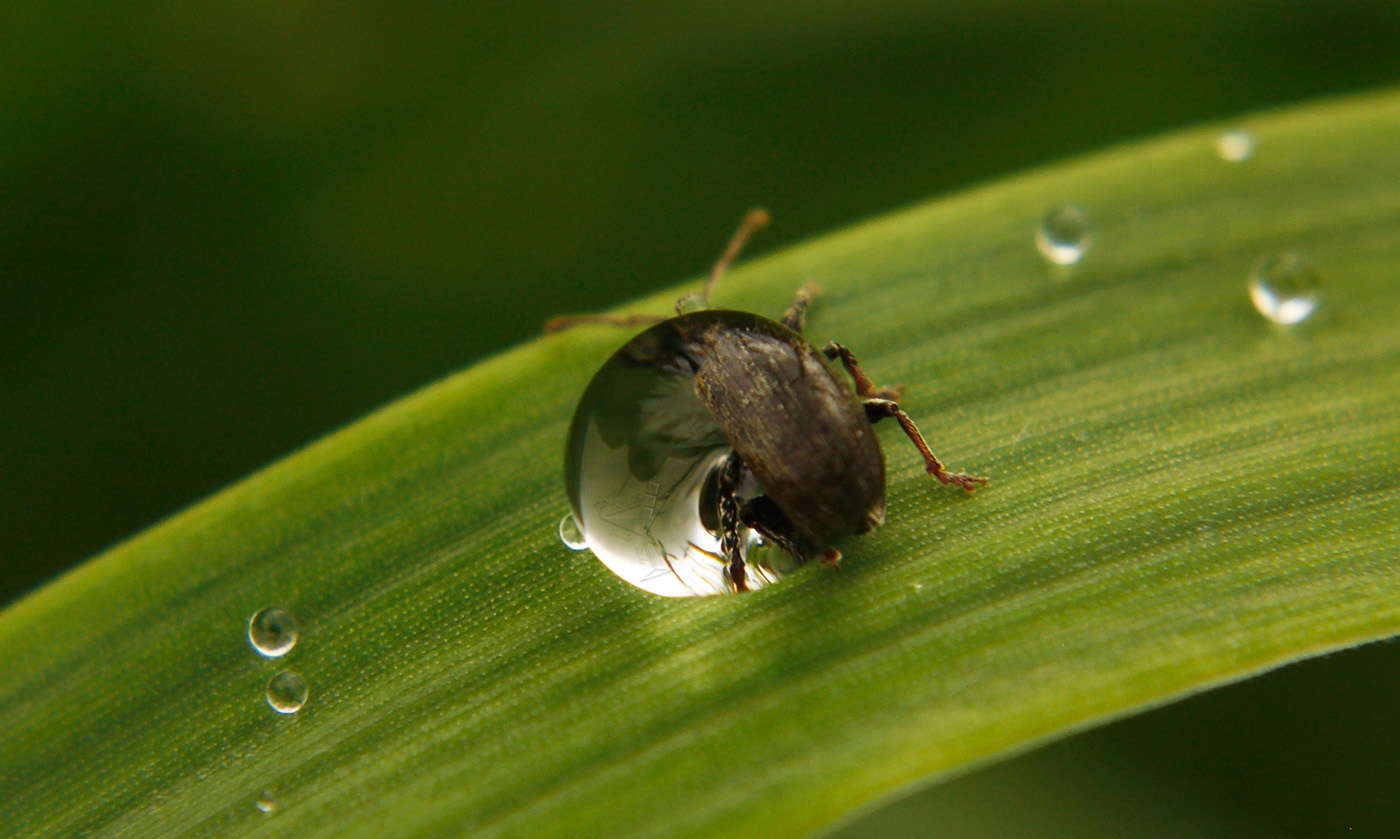
And some of us live in bubbles .... 
A tiny weevil somehow is carrying with him this bubble of water. That is in fact an interesting topic, insects and their water resistancy and how some of them can even walk on water. Another topic for the some other time.


It doesn't look like there is an end to the rainy weather ...